
Featured Research: Human-Derived Tumor-On-Chip Models Are Shaping the Future of Precision Breast Cancer Care
A recent peer-reviewed publication explores how human-derived Tumor-on-Chip technology can improve our understanding of breast cancer heterogeneity and support more personalized treatment strategies. The study also features contributions from Minoo Shahani, CEO of Sein Medical.
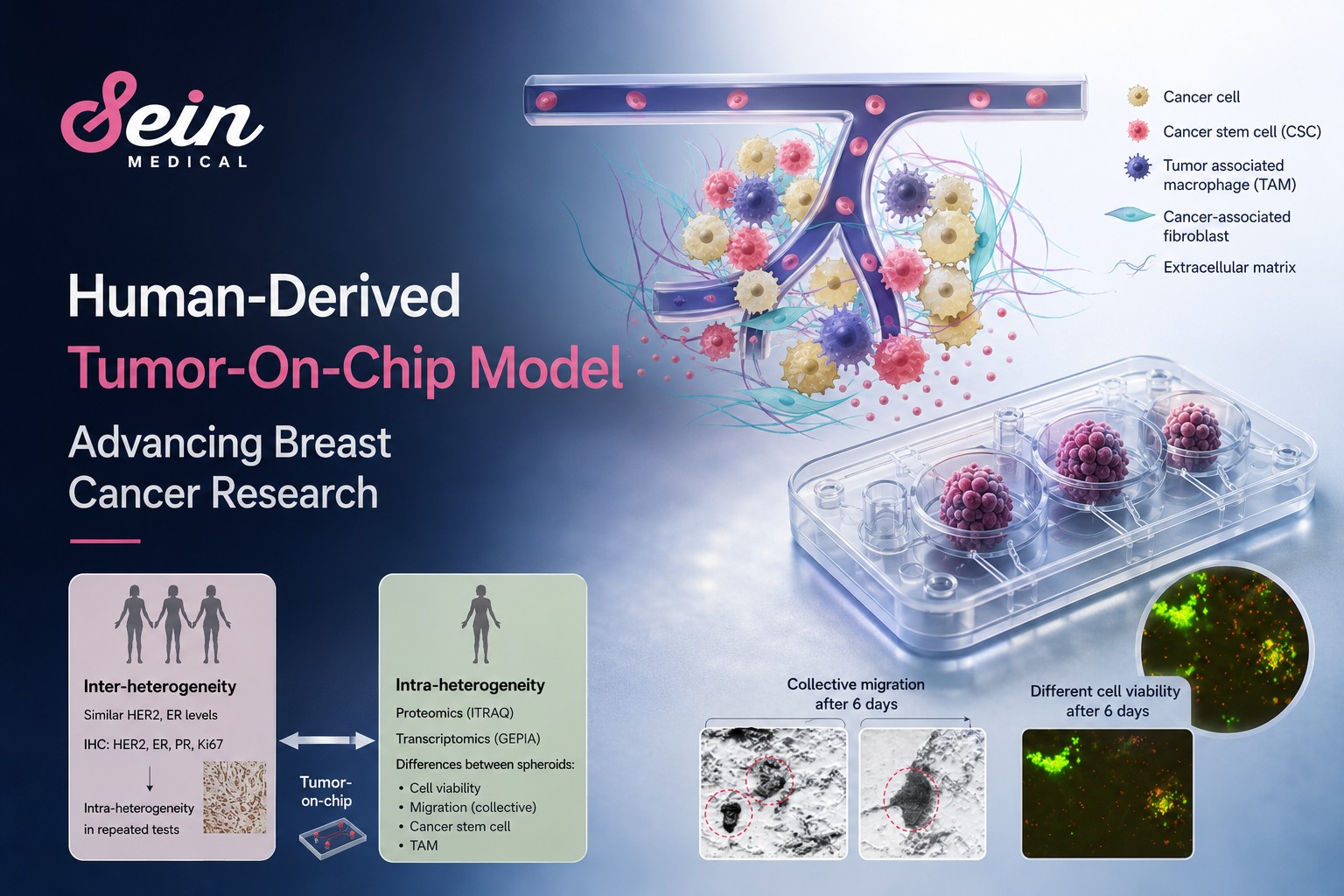
Featured Research: Human-Derived Tumor-On-Chip Models Are Shaping the Future of Precision Breast Cancer Care
Innovation in healthcare begins with scientific discovery.
At Sein Medical, we believe that advancing cancer diagnostics requires not only cutting-edge technology but also a deep understanding of the biological complexity of disease. This commitment to research is reflected in the scientific contributions of our leadership team.
We are pleased to highlight a recently published peer-reviewed study titled "Human-derived Tumor-On-Chip Model to Study the Heterogeneity of Breast Cancer Tissue," published in Biotechnology Advances, one of the leading journals in biotechnology and biomedical research.
The publication brings together researchers from respected universities, cancer research centers, and biomedical institutions, with Minoo Shahani, CEO of Sein Medical, contributing as one of the co-authors.
Understanding Tumor Heterogeneity
Breast cancer is not a single disease.
Even patients with the same clinical diagnosis may have tumors that behave very differently because of tumor heterogeneity—the biological diversity that exists both between patients and within individual tumors.
This complexity is one of the major reasons why predicting treatment response remains challenging.
Understanding these differences is essential for developing more effective and personalized therapeutic strategies.
Why Tumor-on-Chip Technology Matters
Traditional laboratory models often struggle to reproduce the dynamic environment found inside human tumors.
The study explores the use of human-derived Tumor-on-Chip (TOC) technology, a microfluidic platform that enables researchers to culture patient-derived breast cancer spheroids under conditions that more closely resemble the human tumor microenvironment.
Unlike conventional two-dimensional cell cultures, Tumor-on-Chip systems allow researchers to observe how cancer cells interact with surrounding tissues, extracellular matrix components, and immune-related cells over time.
This creates a more realistic experimental platform for studying disease progression.
Key Findings from the Study
The research demonstrates several important observations that contribute to our understanding of breast cancer biology.
Among the findings:
- Human-derived tumor spheroids successfully preserved important characteristics of patient tumors.
- Tumor heterogeneity was associated with differences in HER2 and estrogen receptor (ER) expression.
- Triple-negative breast cancer samples showed higher levels of cancer stem cell markers and tumor-associated macrophages linked to increased invasiveness.
- The stiffness of the extracellular matrix had a significant influence on tumor migration and invasion.
- Tumor-on-Chip technology provided a dynamic environment for evaluating patient-specific tumor behavior that is difficult to reproduce using conventional laboratory methods.
Together, these findings highlight the importance of studying cancer within biologically relevant microenvironments.
Why This Research Matters
The future of oncology is moving toward**** precision medicine.
As researchers continue integrating advanced biological models with artificial intelligence, molecular diagnostics, and biomarker analysis, healthcare providers gain better tools for understanding how each patient's cancer behaves.
Studies such as this contribute to a growing body of evidence supporting more personalized approaches to diagnosis and treatment selection.
For companies like Sein Medical, this scientific direction closely aligns with our vision of combining advanced computational intelligence with biological insight to support smarter cancer diagnostics.
Research-Driven Innovation at Sein Medical
Scientific research is an essential part of innovation.
The participation of Minoo Shahani,CEO of Sein Medical, in this collaborative publication reflects our ongoing commitment to supporting research that advances cancer science and precision healthcare.
We believe that meaningful innovation is built on strong scientific foundations and interdisciplinary collaboration.
Read the Full Publication
If you are interested in breast cancer research, precision medicine, microfluidic technologies, or the future of personalized oncology, we encourage you to read the complete article.
Publication:
Human-derived Tumor-On-Chip Model to Study the Heterogeneity of Breast Cancer Tissue
Published in Biotechnology Advances (2024).
Read the full article on PubMed:
Human-derived Tumor-On-Chip Model to Study the Heterogeneity of Breast Cancer Tissue
Final Thoughts
Progress in cancer care depends on bridging scientific discovery and real-world clinical innovation.
At Sein Medical, we are proud to support research that contributes to a deeper understanding of cancer biology and helps shape the future of precision diagnostics.
We invite researchers, clinicians, students, and healthcare innovators to explore this publication and join the conversation on the next generation of breast cancer research.