
The Role of AI in Modern Healthcare Diagnostics
Artificial intelligence is transforming healthcare diagnostics by improving accuracy, accelerating medical imaging analysis, and supporting smarter clinical decisions. Here’s how AI is reshaping the future of modern medicine.
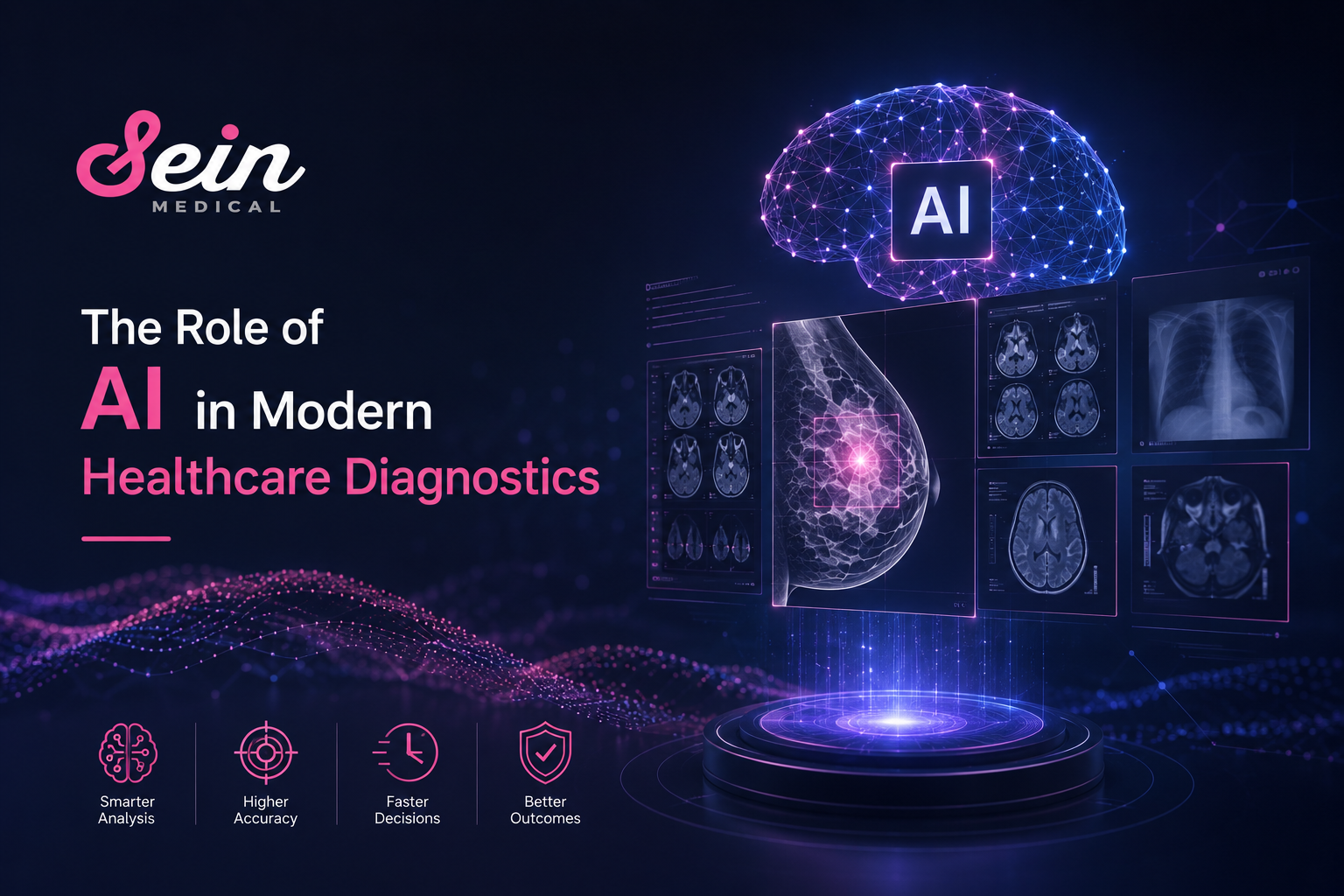
The Role of AI in Modern Healthcare Diagnostics
Healthcare is entering a new era—one driven not only by medical expertise, but also by intelligent technology.
Among the most transformative advancements in recent years is the integration of artificial intelligence (AI) into healthcare diagnostics. From medical imaging to predictive analytics, AI is reshaping how clinicians detect disease, analyze data, and make decisions.
What was once considered experimental is quickly becoming an essential part of modern healthcare systems.
And nowhere is this transformation more visible than in diagnostic imaging.
Why Diagnostics Need to Evolve
Healthcare professionals today face an unprecedented volume of medical data.
Radiologists, pathologists, and clinicians are expected to process:
- Thousands of medical images
- Complex patient histories
- Laboratory results
- Clinical reports
- Risk assessments
All while maintaining speed, accuracy, and patient safety.
Traditional workflows were not designed for this scale of complexity.
As healthcare systems continue to grow, the challenge is no longer simply collecting data—it is interpreting it efficiently and accurately.
This is where AI begins to create meaningful impact.
What AI Actually Means in Healthcare
Artificial intelligence in healthcare refers to computer systems designed to analyze medical information and assist with clinical decision-making.
These systems can identify patterns, detect abnormalities, and generate insights based on large datasets that would be difficult for humans to process alone.
In diagnostics, AI is commonly used for:
- Medical image analysis
- Disease detection support
- Workflow optimization
- Predictive risk assessment
- Clinical prioritization
Importantly, AI is not intended to replace healthcare professionals.
Its real value lies in enhancing human expertise.
AI in Medical Imaging
Medical imaging has become one of the most powerful applications of AI in healthcare.
Using advanced deep learning algorithms, AI systems can analyze imaging data such as:
- Mammograms
- CT scans
- MRI images
- Ultrasounds
- X-rays
These systems are trained on large datasets to recognize patterns associated with disease.
In many cases, AI can help:
- Detect subtle abnormalities earlier
- Reduce interpretation variability
- Improve workflow efficiency
- Support faster reporting
For radiologists managing growing imaging volumes, AI acts as a valuable clinical support tool rather than an automated replacement.
The Rise of Deep Learning
A major driver behind modern healthcare AI is deep learning.
Deep learning models use neural networks capable of learning from massive amounts of data. Over time, these models improve their ability to identify complex patterns and relationships within medical images.
This allows AI systems to become increasingly accurate and adaptive.
In healthcare diagnostics, deep learning has shown strong potential in areas such as:
- Cancer detection
- Tumor classification
- Organ segmentation
- Risk prediction
- Disease progression analysis
The more high-quality data these systems process, the more refined their performance becomes.
Moving Toward Smarter Diagnostics
One of the most important shifts in healthcare is the transition from reactive diagnostics to intelligent, data-driven diagnostics.
Modern AI systems are increasingly being combined with:
- Biomarker analysis
- Patient history
- Genomic insights
- Predictive models
This creates a more comprehensive understanding of patient conditions rather than relying on isolated information sources.
The result is a diagnostic process that is:
- More personalized
- More efficient
- More scalable
- More precise
Healthcare is gradually moving toward systems capable of supporting earlier and smarter interventions.
Addressing Clinical Challenges
AI also has the potential to help solve several longstanding challenges in healthcare diagnostics.
These include:
- Diagnostic delays
- Radiologist workload
- Access disparities
- Inconsistent interpretation
- Rising healthcare costs
By automating repetitive analytical tasks and highlighting high-risk findings, AI allows clinicians to focus more on patient-centered decision-making.
This can improve operational efficiency while also enhancing patient outcomes.
The Importance of Human Oversight
Despite its capabilities, AI is not infallible.
Healthcare decisions involve ethical, clinical, and emotional factors that technology alone cannot fully address.
That is why human oversight remains essential.
Successful AI integration depends on collaboration between:
- Clinicians
- Researchers
- Engineers
- Regulatory bodies
- Healthcare organizations
The future of diagnostics is not human versus machine.
It is human expertise empowered by intelligent systems.
The Future of Healthcare AI
The role of AI in healthcare diagnostics will continue to expand in the coming years.
Future systems are expected to become:
- More predictive
- More personalized
- More accessible
- More integrated into everyday workflows
As technologies mature, AI may help healthcare providers identify disease risk earlier, optimize treatment strategies, and improve healthcare accessibility across underserved populations.
This evolution represents more than technological progress.
It represents a shift toward more intelligent and patient-centered healthcare.
Final Thoughts
Artificial intelligence is no longer a distant concept in medicine.
It is actively shaping the future of diagnostics today.
By combining computational power with clinical expertise, AI has the potential to improve diagnostic accuracy, reduce inefficiencies, and support better healthcare outcomes at scale.
The goal is not to replace the human side of medicine.
The goal is to give healthcare professionals better tools to protect it.