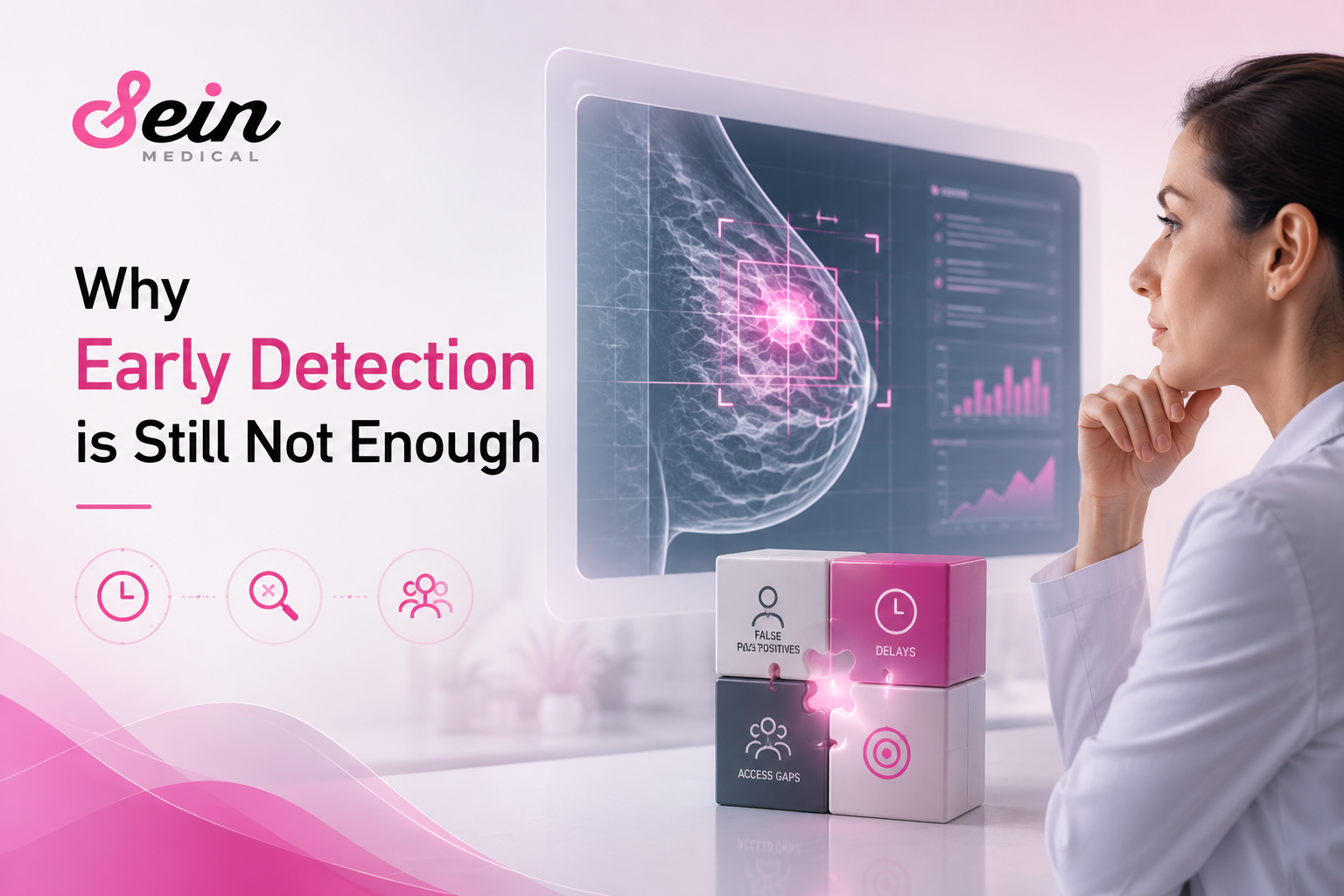
Why Early Detection is Still Not Enough
Early detection has improved breast cancer outcomes worldwide, but traditional screening methods still face major limitations. Discover why the future of diagnostics must go beyond early detection alone.
Why Early Detection is Still Not Enough
For years, early detection has been considered one of the most important strategies in the fight against breast cancer.
And for good reason.
Detecting cancer at an earlier stage can dramatically improve survival rates, expand treatment options, and reduce the physical burden of advanced disease.
But an important question remains:
If early detection is so critical, why do so many patients still face delayed diagnoses, unnecessary procedures, and inconsistent outcomes?
The answer lies in the limitations of traditional screening itself.
Early detection matters. But early detection alone is no longer enough.
The Reality Behind Traditional Screening
Conventional mammography has played a major role in reducing breast cancer mortality. However, despite decades of advancement, screening systems still struggle with several fundamental challenges.
These include:
- False positive findings
- False negative results
- Inconsistent image interpretation
- Limited personalization
- Increasing diagnostic workload
In many cases, traditional screening methods rely heavily on visual interpretation alone. While highly valuable, this approach has limitations—especially when dealing with dense breast tissue or subtle abnormalities.
As healthcare systems continue to generate larger volumes of imaging data, these limitations become more difficult to ignore.
When “Early” Does Not Mean “Accurate”
One of the biggest misconceptions in modern healthcare is the assumption that detecting something early automatically guarantees better outcomes.
But detection without precision can create new problems.
False positives may lead patients toward:
- Additional scans
- Invasive biopsies
- Emotional distress
- Unnecessary treatment decisions
At the same time, missed abnormalities can delay critical interventions.
The challenge is no longer simply finding abnormalities earlier. The challenge is identifying the right abnormalities with greater confidence and accuracy.
The Growing Burden on Radiologists
Modern radiologists operate in an environment of increasing complexity.
Every day, clinicians must review massive volumes of imaging data while balancing:
- Time pressure
- Diagnostic accuracy
- Patient safety
- Clinical documentation
This growing workload increases the risk of fatigue and variability in interpretation.
Even highly experienced specialists can face challenges when evaluating subtle or borderline findings.
Healthcare systems need technologies that support clinicians—not replace them.
Screening Must Become Smarter
The future of breast cancer diagnostics is shifting away from isolated screening toward integrated intelligence.
This means combining:
- Imaging analysis
- Artificial intelligence
- Biomarker insights
- Predictive analytics
- Personalized risk assessment
Rather than relying on a single source of information, smarter diagnostic systems evaluate multiple layers of data to improve clinical confidence and decision-making.
This evolution represents a major transition: from reactive detection → to proactive precision care.
Why Personalization Matters
Not all patients have the same biological profile, risk factors, or disease progression patterns.
Yet traditional screening workflows are often designed around generalized protocols.
This creates a gap between:
- population-level screening and
- individual-level care
Smarter diagnostics aim to close this gap by enabling more personalized assessments based on patient-specific characteristics and biological indicators.
The goal is not only to detect disease earlier—but to understand it more intelligently.
The Role of AI in the Next Generation of Diagnostics
Artificial intelligence is rapidly becoming one of the most important tools in medical imaging.
Advanced AI systems can:
- Detect subtle image patterns
- Reduce variability in interpretation
- Assist with workflow prioritization
- Support faster clinical decision-making
When combined with biomarker analysis and deep learning models, AI has the potential to transform how breast cancer screening is performed.
Importantly, these technologies are designed to enhance human expertise—not eliminate it.
The strongest future for healthcare is one built on collaboration between clinicians and intelligent systems.
Beyond Detection: Building Better Outcomes
The conversation around breast cancer screening must evolve.
Success should no longer be measured only by how early disease is detected, but also by:
- Diagnostic confidence
- Accuracy
- Accessibility
- Speed
- Patient experience
- Long-term outcomes
The future of healthcare belongs to systems that are not only faster—but smarter, more adaptive, and more patient-centered.
Final Thoughts
Early detection changed the landscape of breast cancer care.
Now, healthcare faces the next challenge: making detection more precise, personalized, and intelligent.
Because in modern medicine, finding disease early is only the beginning.
The real goal is delivering the right insight, at the right time, for the right patient.